Anyone who has shared their home with a cat knows these enigmatic creatures don’t bestow their affection equally. Some visitors might receive an indifferent glance, while others are greeted with head-butts, purrs, and the full force of feline charm. This selective behavior isn’t random—it’s a fascinating interplay of biology, psychology, and individual experience that shapes why cats reserve their sweetest gestures for certain people.
At the heart of a cat’s choosiness lies their evolutionary history. Unlike dogs, domesticated over millennia to work alongside humans, cats essentially domesticated themselves. Early wildcats likely gravitated to human settlements for the steady supply of rodents, and over time, the boldest among them tolerated—even sought out—human interaction. This self-reliant ancestry means modern cats retain a strong sense of autonomy. They don’t rely on social hierarchies the way dogs do, so their interactions are less about obedience and more about personal preference. When a cat rubs against your legs or curls up in your lap, it’s not submission—it’s a deliberate choice.
Scent plays a starring role in this feline calculus. Cats navigate the world through their noses, and their vomeronasal organ allows them to detect pheromones undetectable to humans. When a cat sniffs you deeply or rubs their face against you, they’re gathering chemical information. Familiar, comforting scents—like those of a person who feeds them or shares their living space—trigger positive associations. Conversely, strong perfumes, the smell of other animals, or even stress hormones (which cats can detect) might make them wary. This explains why the neighbor who always wears floral perfume gets the cold shoulder, while the quiet roommate who smells like home gets nightly cuddles.
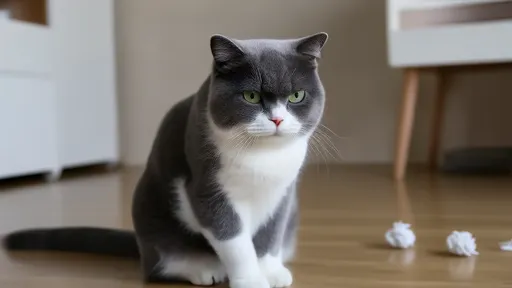
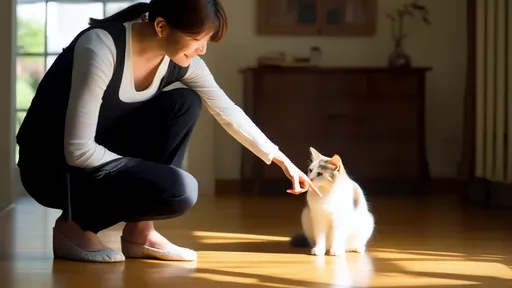
Beyond smell, cats are master observers of human behavior. They notice patterns we might not even recognize in ourselves. A person who moves predictably, speaks in soft tones, and respects a cat’s boundaries often becomes a favorite. Cats particularly appreciate humans who understand the art of the slow blink—a gesture in feline body language that signals trust and relaxation. Those who mimic this behavior (often without realizing it) may find themselves on the receiving end of purrs and kneading. On the flip side, people who stare directly at a cat or approach too quickly trigger instinctive defensiveness; in the wild, direct eye contact is a threat.
Timing matters just as much as technique. Cats are crepuscular, meaning they’re most active at dawn and dusk. Someone home during these hours—say, a night-shift worker or a freelancer with a flexible schedule—has a built-in advantage in bonding. These are prime times for play and interaction, so the person available for feather wand sessions or early morning chin scratches becomes associated with high-value activities. The same cat might ignore a nine-to-five office worker simply because their schedules rarely overlap with peak feline social hours.
Personality compatibility is another often-overlooked factor. Research suggests cats may gravitate toward humans whose energy levels match their own. A high-strung, talkative person might overwhelm a shy cat but entertain an outgoing one. Similarly, a calm, quiet individual could soothe an anxious feline but bore a playful kitten. Some cats even develop preferences based on human gender or vocal pitch, possibly due to past positive or negative experiences. A cat rescued by a gentle-voiced woman, for instance, might remain wary of deep male voices years later.
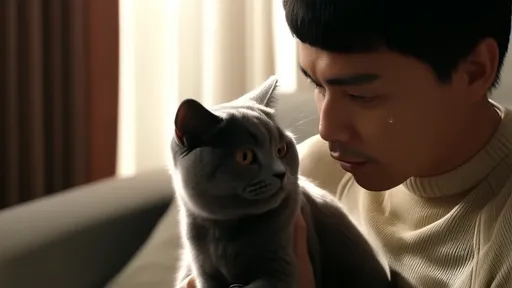
The mystery deepens when considering how cats perceive human emotions. While the science isn’t definitive, many owners report their cats becoming extra affectionate during times of illness or sadness. Some researchers theorize cats recognize changes in breathing patterns, body temperature, or even subtle chemical shifts when humans are unwell. Others suggest the reduced movement of an ill or depressed person makes them less intimidating. Whatever the mechanism, this apparent empathy—real or coincidental—strengthens bonds with certain individuals during vulnerable moments.
Early life experiences cast long shadows over a cat’s social preferences. Kittens handled gently by multiple people between two and seven weeks old typically grow into more sociable adults. Conversely, those with limited positive human contact during this critical window may always be wary. But cats can also form strong attachments to individuals who’ve nurtured them through trauma, even if that bonding occurs in adulthood. A formerly feral cat might reserve trust for the one person who patiently earned it over months of shared meals, while ignoring other household members entirely.
The most intriguing aspect? Cats sometimes choose their humans against all logic. There are countless stories of cats shunning the person who feeds them in favor of someone who barely acknowledges them. This capriciousness is part of what makes feline affection so rewarding—it feels genuinely earned rather than obligatory. When a cat curls up on your keyboard while you work or gifts you a dead mouse (their highest honor), it’s not because they’ve been trained to please. It’s because, in their inscrutable feline judgment, you’ve passed some secret test.
Understanding these preferences isn’t just academic—it can improve human-cat relationships. For those hoping to win over a particular cat, the formula involves patience, respect for boundaries, and keen observation. Let the cat initiate contact, offer treats without expectation, and learn their body language. The payoff—a purring, biscuit-making companion who chose you—is well worth the effort. After all, in a world where dogs love everyone and children love freely, a cat’s carefully measured affection reminds us that trust, when given selectively, carries extraordinary weight.
By /Jun 12, 2025
By /Jun 12, 2025
By /Jun 12, 2025
By /Jun 12, 2025
By /Jun 12, 2025
By /Jun 12, 2025
By /Jun 12, 2025
By /Jun 12, 2025
By /Jun 12, 2025

By /Jun 12, 2025
By /Jun 12, 2025
By /Jun 12, 2025
By /Jun 12, 2025
By /Jun 12, 2025
By /Jun 12, 2025
By /Jun 12, 2025
By /Jun 12, 2025
