For centuries, cats have been shrouded in an aura of mystery, often labeled as aloof or indifferent compared to their canine counterparts. Yet, emerging research suggests that our feline companions might understand us far better than we think—particularly when it comes to human gestures like pointing. The question of whether cats comprehend human pointing isn’t just academic; it reveals deeper layers of cross-species communication and the blind spots in our assumptions about animal cognition.
Unlike dogs, which eagerly follow human pointing gestures to locate hidden treats or toys, cats have long been perceived as uninterested in such overt communication. This perception, however, may say more about human biases than feline capabilities. Recent studies challenge the notion that cats are oblivious to our gestures, proposing instead that their responses are nuanced and context-dependent. The key lies in decoding the subtle ways cats process and react to human body language—a language they didn’t evolve to instinctively "speak," but one they can learn to interpret.
The Science Behind Feline Comprehension
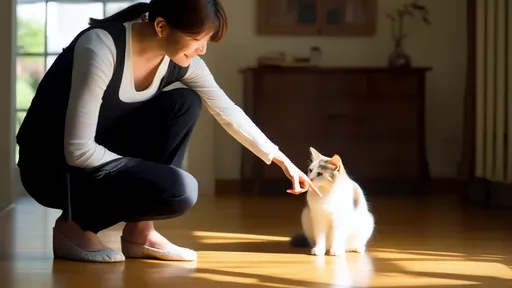
In a groundbreaking 2005 study published in Animal Cognition, researchers tested whether cats could follow a human’s pointing finger to find food. The results were mixed: while some cats successfully followed the gesture, others ignored it entirely. This variability sparked debates. Were the failures due to a lack of understanding, or simply a lack of motivation? Unlike dogs, bred for centuries to collaborate with humans, cats were domesticated primarily for pest control—a solitary task requiring little human interaction. Their evolutionary path didn’t prioritize interpreting human cues, yet many cats do learn to respond, especially when raised in socially enriched environments.
Later research delved deeper into the conditions that influence a cat’s responsiveness. Factors like the familiarity of the person pointing, the cat’s individual personality, and even the presence of competing stimuli (like a rustling toy) all play a role. For instance, a 2017 study found that cats were more likely to follow pointing gestures from their owners than from strangers, suggesting that trust and bonding enhance communication. This aligns with anecdotal evidence from cat owners who report their pets responding to subtle cues like gaze direction or slight hand movements—gestures that wouldn’t register with an untrained animal.
The Role of Domestication and Social Learning
Domestication has undeniably shaped feline behavior, but not in the same way it has for dogs. Cats entered human lives on their own terms, retaining much of their independence. Yet, over thousands of years of coexistence, they’ve developed a unique ability to "read" human behavior selectively. Kittens raised around humans who frequently use gestures, for example, are more likely to respond to pointing than feral cats. This hints at social learning: cats aren’t hardwired to understand pointing, but they can acquire the skill through observation and repetition.
Interestingly, cats may also use their own subtle gestures to communicate with humans—tail flicks, ear twitches, or prolonged blinks—many of which go unnoticed by their owners. This asymmetry in cross-species communication creates a "blind spot." Humans expect overt responses like those from dogs, while cats operate on a different wavelength. Recognizing this disconnect is crucial. When a cat fails to follow a pointed finger, it’s not defiance or stupidity; it’s often a mismatch between human expectations and feline communication styles.
Practical Implications for Cat Owners
Understanding how (and whether) your cat interprets pointing can strengthen your bond. Start by observing their natural tendencies. Does your cat watch your hands when you gesture? Do they follow your gaze? If not, try pairing pointing with rewards. For example, point directly at a treat while saying "look," then immediately give it to them. Over time, they may associate the gesture with the action. Patience is key; unlike dogs, cats rarely respond to forced training. The process must align with their independent nature.
It’s also worth noting that cats excel at reading other forms of human body language. They notice changes in posture, tone of voice, and even emotional states. A pointed finger might not always register, but a crouched posture or excited voice could instantly grab their attention. This adaptability highlights their intelligence—just not in the ways humans typically measure it.
Breaking the "Aloof" Stereotype
The myth of the indifferent cat persists partly because humans misunderstand feline communication. Where dogs wear their hearts on their sleeves, cats communicate in whispers. A flick of the tail or a slow blink can convey volumes—if we’re paying attention. The fact that some cats do understand pointing, even if inconsistently, proves they’re capable of complex social cognition. It’s not that they can’t understand us; it’s that they often choose not to, unless the interaction aligns with their terms.
Future research could explore how early exposure to human gestures shapes feline responsiveness, or whether certain breeds (like the highly social Siamese) are more predisposed to follow pointing. For now, the takeaway is clear: cats are far more attuned to humans than we’ve given them credit for. The real blind spot isn’t in their comprehension—it’s in our ability to recognize their subtle, sophisticated language.
By /Jun 12, 2025
By /Jun 12, 2025
By /Jun 12, 2025
By /Jun 12, 2025
By /Jun 12, 2025
By /Jun 12, 2025
By /Jun 12, 2025
By /Jun 12, 2025

By /Jun 12, 2025

By /Jun 12, 2025
By /Jun 12, 2025
By /Jun 12, 2025
By /Jun 12, 2025
By /Jun 12, 2025
By /Jun 12, 2025
By /Jun 12, 2025
By /Jun 12, 2025
