For centuries, cats have been enigmatic companions, often painted as aloof and indifferent to human emotions. Yet, anyone who has shared a home with a feline knows there’s more beneath the surface. Recent scientific inquiries into feline behavior have sought to answer a compelling question: Can cats truly sense human sadness? The emerging research suggests that the bond between cats and their owners might be far more nuanced than previously assumed.
A study published in the journal Animal Cognition explored whether domestic cats could recognize and respond to human emotional cues. Researchers observed how cats reacted to their owners’ simulated crying versus neutral humming. The results were intriguing—many cats displayed behaviors such as approaching their owners, purring, or gently rubbing against them when they perceived distress. While not all felines responded identically, the trend hinted at a capacity for emotional attunement.
What makes this finding particularly fascinating is the evolutionary context. Unlike dogs, which were bred over millennia to work alongside humans, cats domesticated themselves, largely retaining their independence. Their ability to pick up on human emotions, then, may stem from a different adaptive strategy—one rooted in subtle social intelligence rather than overt cooperation. Some scientists speculate that cats, as solitary hunters, evolved to detect subtle shifts in their environment, including the emotional states of those around them.
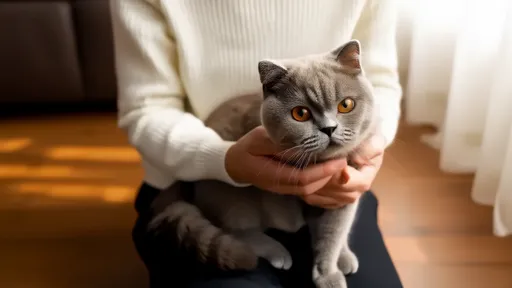
But how does this translate to real-life interactions? Cat owners often report anecdotes of their pets curling up beside them during illness or emotional distress. One theory is that cats associate certain human behaviors—like a slumped posture or quieter speech—with vulnerability, prompting a protective or comforting response. Alternatively, they may simply mirror the energy of their environment; a calm, subdued owner might encourage a cat to settle nearby. Regardless of the mechanism, these observations challenge the stereotype of the detached feline.
Critics, however, urge caution. Unlike dogs, whose empathetic behaviors are well-documented, cats are harder to study due to their unpredictable nature. Some argue that what appears to be empathy could instead be curiosity or a learned response to attention-seeking. For instance, a cat that receives affection after approaching a crying owner might repeat the behavior for rewards rather than genuine concern. Disentangling instinct from learned behavior remains a challenge in feline cognition research.
Despite the debate, one thing is clear: the emotional lives of cats are richer than we once thought. Whether driven by empathy, social bonding, or environmental cues, their reactions to human sadness reveal a depth of connection that science is only beginning to unravel. For now, the mystery of the feline mind endures—much like the cats themselves, it seems to reveal its secrets on its own terms.

By /Jun 12, 2025

By /Jun 12, 2025

By /Jun 12, 2025
By /Jun 12, 2025

By /Jun 12, 2025

By /Jun 12, 2025

By /Jun 12, 2025

By /Jun 12, 2025

By /Jun 12, 2025

By /Jun 12, 2025
By /Jun 12, 2025

By /Jun 12, 2025

By /Jun 12, 2025
By /Jun 12, 2025

By /Jun 12, 2025

By /Jun 12, 2025

By /Jun 12, 2025
