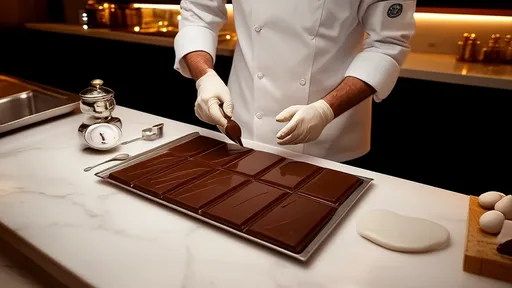
The art of chocolate tempering remains one of the most crucial yet delicate processes in confectionery. Achieving that perfect snap, glossy sheen, and stable crystalline structure requires precision, patience, and an understanding of cocoa butter's complex behavior. Among the various tempering techniques, the seeding method has gained prominence for its reliability in controlling temperature while maintaining the chocolate's visual and textural integrity. This approach not only simplifies the process but also ensures consistent results, making it a favorite among both artisanal chocolatiers and large-scale producers.
At the heart of the seeding method lies the principle of introducing already-tempered chocolate crystals into melted chocolate to encourage proper crystallization. Unlike traditional tempering, which relies solely on precise temperature manipulation, seeding leverages the stability of pre-existing beta crystals to guide the entire batch toward the desired crystalline form. The process begins with gently melting two-thirds of the chocolate to a temperature high enough to eliminate all unstable crystals—typically around 45-50°C for dark chocolate, slightly lower for milk and white varieties. Care must be taken not to overheat, as excessive temperatures can permanently damage the cocoa butter's crystalline structure.
The magic happens during the cooling phase, where the remaining one-third of finely chopped tempered chocolate—the "seed"—is gradually incorporated. As the seed melts into the warm chocolate, it disseminates stable beta crystals throughout the mixture. These crystals act as templates, encouraging the liquid cocoa butter to solidify in the same stable pattern. The mixture must be cooled to around 28-29°C for dark chocolate or 27-28°C for milk and white chocolate, all while continuously stirring to ensure even distribution of temperature and crystals. This gradual cooling is critical; rushing the process risks creating unstable crystal forms that result in dull, crumbly chocolate.
Maintaining the chocolate's glossy appearance depends heavily on proper crystal formation and temperature management throughout the tempering process. The seeding method excels in this regard by promoting the growth of Form V beta crystals, which are responsible for chocolate's characteristic shine and snap. However, even with perfect tempering, environmental factors can compromise the final product. Humidity represents one of the greatest threats to chocolate's luster, as moisture causes sugar to bloom to the surface, creating a whitish haze. Similarly, rapid temperature fluctuations after tempering can cause fat bloom, where cocoa butter rises to the surface and crystallizes unevenly. Professional chocolatiers often work in climate-controlled environments below 20°C with humidity under 50% to prevent these issues.
The viscosity of tempered chocolate plays an often-overlooked role in achieving that mirror-like finish. Properly tempered chocolate should flow smoothly but not too thinly, allowing it to coat molds or dipped items evenly. If the chocolate becomes too thick during the cooling process, gentle warming to no more than 32°C can restore workability without destroying the temper. This delicate balance requires constant attention; even a few degrees too high will melt the stable crystals, while too cool makes the chocolate unworkable. Many professionals use marble slabs or specialized tempering machines to maintain this precision, though skilled hands can achieve excellent results with simple tools and a reliable thermometer.
Beyond temperature control, the quality of chocolate used for seeding dramatically affects the final product's shine and stability. High-quality couverture chocolate with a high cocoa butter content (minimum 32% for dark) provides the best results, as it contains more of the stable crystals needed for proper tempering. The seed chocolate should be fresh and well-tempered itself—using poorly stored or bloomed chocolate as seed can introduce unstable crystals that propagate through the entire batch. Some chocolatiers keep a portion of their previous perfectly tempered batch specifically for seeding, creating a continuity of quality across production runs.
Testing the temper remains an essential step before committing large quantities of chocolate to molds or coatings. The classic test involves spreading a thin layer on parchment paper or the back of a knife and observing its setting behavior. Properly tempered chocolate should set within 3-5 minutes at room temperature (around 20°C) with a uniform glossy appearance and no streaks. If streaks or dull spots appear, the chocolate may need additional seeding or careful temperature adjustment. Many professionals also check the chocolate's viscosity and adhesion properties, as properly tempered chocolate should coat surfaces evenly without running too thin or clumping.
The seeding method's versatility extends beyond traditional chocolate bars and truffles. It proves particularly valuable when working with colored cocoa butters or creating intricate decorative elements where visual perfection is paramount. The controlled crystallization prevents mottling or uneven coloration that can occur with less precise tempering methods. For applications requiring exceptionally thin coatings, such as chocolate lace or transfer sheets, the seeding method's reliability in maintaining proper viscosity becomes indispensable. Even when incorporating flavors or additives, the seeding approach helps maintain structural integrity where other methods might fail.
While the seeding method offers numerous advantages, it does require an understanding of chocolate's unique properties to execute flawlessly. The ratio of seed to melted chocolate varies slightly depending on ambient conditions and the specific chocolate used—a fact learned through experience rather than rigid formulas. Similarly, the ideal working temperature might shift by half a degree based on humidity or the chocolate's origin. Mastering these nuances separates adequate tempering from exceptional results, where every piece shines like polished mahogany and breaks with that satisfying snap that signals perfectly formed crystals.
Modern technology has introduced tools that simplify the seeding process without sacrificing quality. Digital thermometers with precision to 0.1°C, immersion circulators for water baths, and even ultrasonic devices that promote crystallization have entered professional kitchens. However, the fundamental principles remain unchanged: melt carefully, cool gradually with quality seed, and maintain the precise temperatures that allow only the most stable crystals to flourish. When executed with care, the seeding method produces chocolate that not only looks magnificent but also has superior shelf stability and mouthfeel—qualities that define truly exceptional confections.

By /Jun 18, 2025

By /Jun 18, 2025
By /Jun 18, 2025
By /Jun 18, 2025

By /Jun 18, 2025

By /Jun 18, 2025
By /Jun 18, 2025

By /Jun 18, 2025
By /Jun 18, 2025
By /Jun 18, 2025
By /Jun 18, 2025
By /Jun 18, 2025
By /Jun 18, 2025

By /Jun 18, 2025
By /Jun 18, 2025
By /Jun 18, 2025
